
Enough land: 2025 update
Solar development and NYS agriculture

In my 2023 Substack publication “Enough land: How will solar development affect upstate New York agriculture?” I looked at the land requirements for solar buildout in upstate NY between now and 2050. The 65-page white paper estimated how much of this buildout is likely to occur on farmland and examines the expected impact on agriculture. One of the most striking things I learned in writing the paper was that NYS has been losing farmland at an astonishing rate apart from widespread solar buildout. Solar development simply adds pressure to an existing problem.
In 2024, the results of the 2022 USDA Census of Agriculture became available. My original publication relied heavily on 2017 Census data, so I wanted to know how the new Census differed. Were we still losing farmland at the same rate?
How much solar capacity does NYS need?
“Enough land” used the Scoping Plan developed by the NYS Climate Action Council and other sources to estimate that we will need 65,000 MW by 2050. This total assumes that our electric use will approximately double by 2050. In 2025, the New York Independent System Operator (NYISO) projected that demand will double within that timeframe; in fact, the NYISO high-demand scenario calls for even more consumption.[i]
Still unknown: the impact of new demand from data centers. These include facilities used for cloud computing, generative AI, cryptocurrency data mining, and other intensive computing purposes. By 2030, US consumption from these facilities is likely to increase to as much as 9% of our total electric use.[ii] With some of the country’s highest electric rates, NYS is not in an ideal position to attract these facilities, but rural upstate areas with lower electric rates have seen growing interest.
Note that solar development can be divided into grid-scale (facilities >20 MW) and distributed (smaller facilities, including community solar). The latter is being developed relatively quickly. In 2024, though, only 15 grid-scale solar projects generated electricity for NYS, providing about 530 MW of capacity. By 2050, the majority of solar buildout is expected to comprise grid-scale plants, but in 2024, only 0.38% of NYS electric generation came from such projects. The graphic here shows the percentage of electricity generated by grid-scale solar development in relation to other sources in 2024:
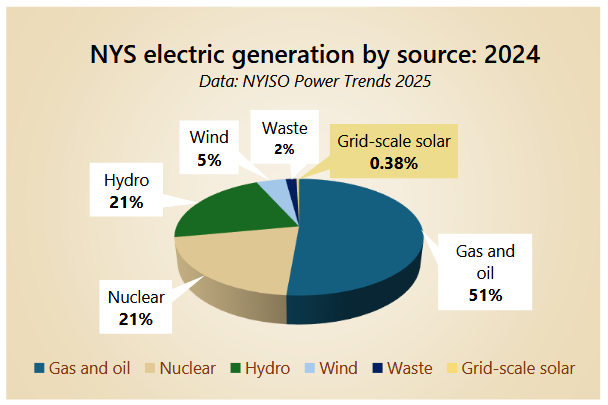
Clearly, grid-scale solar development is moving slowly in NYS. It takes an average of almost six years to complete a grid interconnection request,[iii] for instance. An analysis of recently operational large-scale renewable energy projects showed they were averaging six to eight years from bid submission to operation.[iv]
How much land is required for solar projects?
“Enough land” estimated that 1 MW of solar capacity requires about 6 acres of land. That remains unchanged. Actual amounts of land taken out of production for solar development are consistently well over 6 acres, taking into account land required for setbacks, screening, parking, etc. Even for small utility-scale solar projects, entire parcels are generally removed from production—not just the 6 acres per MW covered by equipment. For example, a 5-MW project might cover 25 acres, but the entire 32-acre parcel on which it is located might be removed from production.
“Enough land” estimated that at 6 MW per acre, solar buildout in NYS will require 390,000 acres by 2050. That’s about 1.3% of the state’s land area. This acreage remains unchanged from 2023.
How much of this land will be agricultural?
In its research for the Farmland Under Threat 2040 initiative, American Farmland Trust (AFT) estimated that 83% of future solar development would take place on farmland.[v] This national figure roughly agrees with the 84% estimated by Cornell researchers specifically for NYS.[vi] In 2050, that amount is expected to total 327,600 acres of farmland. I am continuing to use the NYS-specific number, with 85% of farmland-based solar development taking place on cropland, or 278,460 acres by 2050. Cropland has the characteristics best suited to solar development; it is typically flat, open, sunny, and located near transmission and transportation infrastructure. “Enough land” determined that about half of cropland comprises prime farmland.
How much farmland does NYS have?
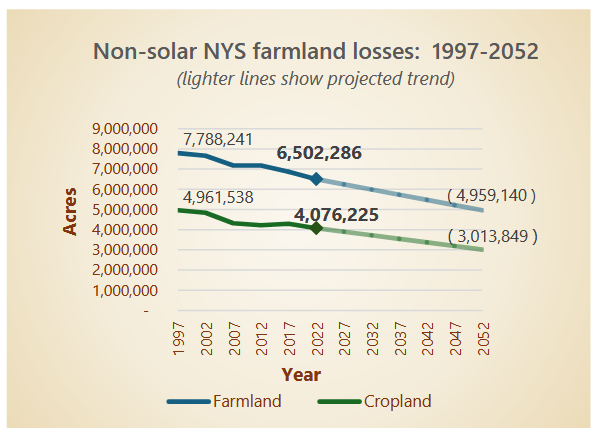
In 2017, NYS had 6,866,171 acres of farmland,[vii] including 4,291,388 acres of cropland.[viii] These figures formed the basis for many of the calculations in “Enough land.” In 2022, NYS land in farms decreased to 6,502,286 acres, with 4,076,225 acres of cropland. This change means we experienced a 5.3% loss in farmland and 5% loss in cropland over those five years. The loss is similar to what occurred over the five years preceding 2017.
It also extends a much longer trend of farmland loss in NYS. In 1925—a century ago—NYS had 20,632,803 acres of farmland. That was down 6.3% from 1910. NYS has been losing farmland as long as we’ve been tracking it. Very little farmland loss can be attributed to solar development at present; the vast majority of solar buildout has yet to occur. We have probably constructed solar facilities on approximately 23,000 acres of farmland thus far.[ix]
As we lost an average of more than 50,000 acres of farmland a year between 1997 and 2022, future decreases are likely to be considerable. The following chart shows losses since 1997 and projects future losses at five-year intervals through 2052 at the same rate:
Do we have enough land for agriculture and solar buildout?
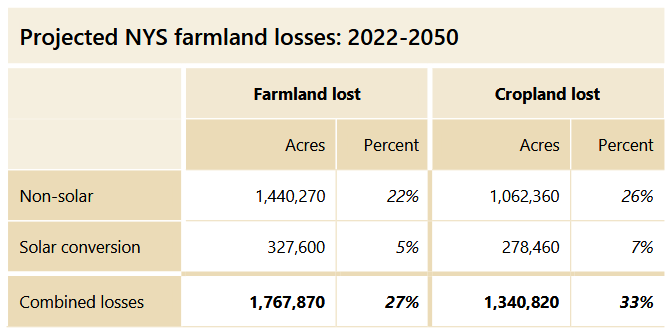
To answer this question thoughtfully, we must consider how much farmland not counting solar development is likely to be lost between now and 2050: about 1.4 million acres.
If we build out solar as planned by 2050, we will be using about 5% of NYS’s current farmland for projects, including about 7% of the state’s cropland. Approximately 7% of NYS’s prime farmland is likely to be used for solar development. The table below shows what we can expect by 2050.
What impacts do solar projects have on farmland?
Solar developers often promote their projects as having little impact on the land where they are sited. Often, they claim that at the end of the panels’ lifespan, the entire project can be removed and the land simply returned to tillage. It should be noted that this process has not been carried out on an actual utility-scale solar site.
Modern solar projects typically use panels with an expected lifespan of 25-30 years. At the end of this period, the project may be decommissioned or repowered (see my post “Repowering solar projects”). Repowering appears likely in many cases, if not most.
Some of the issues that may arise if the project site is returned to agricultural production include:
Compaction, especially of certain soils, from construction, maintenance, and stormwater runoff. Soil will probably need to be decompacted prior to resuming agricultural use, as compaction may decrease future yields and change stormwater runoff patterns.
“Striping” of soils located under panels and between panel rows. In one of the few longer-term studies of the effects of solar installations on farm soils, it was noted that soils beneath panels lost key nutrients and water-holding capability over a period of seven years,[x] while soils between the rows of panels did not. This “striping” resulted in an uneven distribution of nutrients and soil characteristics that would need to be remedied at the time of decommissioning, a process that might well take years to fully rectify.
Damage to drainage structures. Drainage tile and other structures can be damaged during construction. Removing or replacing them may be challenging, as ground-buried wires below a specific depth are usually left in place during decommissioning.
Potential leaching from panels, wires, racking, and other components, especially if panels break or delaminate. Research indicates that levels of some metal and metalloid substances increased near panels but typically did not reach a hazardous threshold during normal, short-term use.[xi], [xii] No field research has addressed either the long-term potential for leaching or examined what happens when panels are damaged. We have seen damaged panels left in place for many months at a time, so there is a clear need for additional research.
With thousands of acres of solar development now in production and many more planned, it is essential that we know what happens to soil under panels. We know that panels may pose an environmental hazard in landfills (see my post “Solar panels and recycling in NYS”), but we know surprisingly little about their effects during use. The leaching of lead under landfill conditions[xiii] is particularly concerning, as it raises the possibility that the same could occur as the result of breakage or delamination. The leaching of PFAS has not been studied at all, even though PFAS chemicals are widely used in panels, wiring, coatings, and other components.
In short, returning solar projects to agricultural use upon decommissioning appears considerably more complex—and problematic—than just pulling up racking and tilling the soil. Until we know exactly what measures will be required, we should not consider solar facilities a temporary form of development.
Are there other impacts on farming?
In “Enough land,” I noted that the cumulative development of solar facilities in certain geographic areas may cause difficulties for local agricultural economies. Businesses that support agriculture may suffer when agricultural activity declines due to multiple grid-scale solar projects in an area.
Farmers who rely on renting land may be at a disadvantage, too. They cannot compete with solar developers for land leases; in 2024 cropland rentals averaged $83.50/acre,[xiv] whereas solar developers typically pay at least $1,000/acre. Dairy farmers in NYS often rent land and use farmland for spreading manure on a large scale.
AFT and other organizations have observed that increasing numbers of people are going into farming who have no family connections to farms; they are buying existing farmland. Doing so has become increasingly challenging when they must compete with solar developers.
What about agrivoltaics?
AFT and other farming organizations seem to have thrown their weight behind agrivoltaics: the dual use of land for solar development and agriculture. AFT has published a formal, detailed definition of agrivoltaics, but the term is often used very freely.
“Sheepwashing”
Grazing sheep on solar sites reduces the need for mechanical mowing as a maintenance strategy. While practical for site management, sheep grazing is not a particularly good use of highly productive soils. Solar developers increasingly refer to solar grazing as “agrivoltaics,” leading some to refer to such approaches disparagingly as “sheepwashing.” Solar developers have capitalized on the fact that many people find sheep a pleasant novelty around solar sites and seem to enjoy the juxtaposition of high-tech development with low-tech maintenance. Most project applications mention solar grazing as a possibility, if not a clear intention. And solar grazing may be cheaper than mowing.
Solar grazing generally doesn’t meet the AFT definition of agrivoltaics. Most solar projects that include sheep grazing are not designed for agricultural production. They normally lack important infrastructure such as multiple water sources, shelter and storage structures, and rotational fencing. In these cases, grazing remains a secondary activity, with energy production as the primary focus.
To be sure, real agrivoltaics offers some hope for combining agricultural and energy production in the future. Certain crops grow well under panels, for example. But most agrivoltaic projects that incorporate agricultural production as an integral part of their design tend to produce expensive food and expensive energy, especially when elevated panels are used over crops. In Italy, where agrivoltaics are mandated on farmland, large subsidies have been required to construct facilities.[xv]
Conclusions
NYS still has a dynamic agricultural sector. It grows and processes a wide range of foods and other products. It features relatively small farms; the average is about 200 acres. Most NYS farms (95%) are family-run.
The results of the 2022 Census of Agriculture reinforce the conclusions of my original white paper. If anything, we’re losing agricultural land faster than I projected originally. Grid-scale solar buildout is moving at a crawl, with less than 1% of the 2050 total completed. The buildout of smaller projects is going more quickly but will have a less dramatic impact on agricultural land use.
More than a quarter of the state’s present farmland and a third of its cropland may be at risk from combined solar and non-solar development by 2050. These numbers mean we must look hard at all proposals that remove farmland from production.
It’s too easy to look at a given solar project and conclude that it has little agricultural impact because it takes only a few dozen—or a few hundred—acres out of production. We can’t afford to look at these projects in isolation, though. We need to consider the broader issue of farmland loss across NYS and decide whether this is the most productive use of the land in question. The quality of the land matters, as do the cumulative impacts of solar development.
The best land for farming is often the most convenient land for solar. Many organizations, institutions, and governments have issued guidelines for “smart” solar siting, emphasizing practices such as siting solar on brownfields or other previously disturbed land and marginal farmland. Unfortunately, following these practices can be expensive and inconvenient for solar developers. Marginal farmland is less likely to be flat, or located near roads and transmission lines, for example. Brownfield land is often confined to parcels under 100 acres, making it unsuitable for large solar facilities.
Most municipal governments tend to prioritize bringing in new revenues; because agricultural land is taxed at a lower rate, it can be seen as not particularly valuable. Officials approving projects are more likely to be interested in increasing revenues from a given parcel than in retaining productive farmland. Few communities consider overall NYS farmland loss in making decisions about solar.
State officials offer the usual suggestions to developers about avoiding farmland with productive soils but in practice have taken an extremely soft stance on building out solar on farmland. Currently there are modest penalties in place for converting large amounts of land with highly productive soils, but these penalties seem to be an accepted cost of doing business for most developers and don’t appear to act as a deterrent. The state didn’t even track the use of farmland for solar until recently. Rather than adopting a conservative definition of agrivoltaics, NYS has accepted solar grazing, pollinator-friendly plantings, and conservation measures as replacements for agricultural production.[xvi]
I’ll keep updating “Enough land.” Thanks for reading. If you found this post interesting, please give it a like to boost its position in searches.
[i] NYISO, 2025 Power Trends, https://www.nyiso.com/documents/20142/2223020/2025-Power-Trends.pdf/51517a1b-36fa-4f3d-d44d-eabe23598514.
[ii] Kayla Zhu, Mapped: Data Center Electricity Consumption By State, Visual Capitalist, https://www.visualcapitalist.com/mapped-data-center-electricity-consumption-by-state/.
[iii] Chris Talley, Steven Zhang, State of interconnection queues — January 2024, 17 January 2024, https://www.interconnection.fyi/blog/state-of-interconnection-jan-2024, accessed 19 July 2025.
[iv] Po-Yu Yuen, Chinmayee Atre, What will it take for New York’s Tier 1 large-scale renewables to deliver on CES Biennial Review timeline? 19 November 2024, https://sea-ee.com/blog-post/what-will-it-take-for-new-yorks-tier-1-large-scale-renewables-to-deliver-on-ces-biennial-review-timeline/.
[v] American Farmland Trust, Smart Solar℠ on Farmland and Ranchland, 2022, https://farmland.org/files/aft_smart-solar-handout-general-d-(1).pdf.
[vi] Venktesh V. Katkar, Jeffrey A. Sward, Alex Worsley, K. Max Zhang, Strategic land use analysis for solar energy development in New York State, Renewable Energy, Volume 173, 2021, Pages 861-875, ISSN 0960-1481, https://doi.org/10.1016/j.renene.2021.03.128.
[vii] Farmland, or “land in farms,” comprises cropland, pastureland, and wooded farmland.
[viii] USDA Census of Agriculture 2017 and 2022, State Summary Highlights, https://www.nass.usda.gov/Publications/AgCensus/2017/Full_Report/Volume_1,_Chapter_2_US_State_Level/st99_2_0001_0001.pdf, https://www.nass.usda.gov/Publications/AgCensus/2022/Full_Report/Volume_1,_Chapter_2_US_State_Level/st99_2_001_001.pdf, accessed 17 July 2022.
[ix] Grid-scale buildout is estimated at 530 MWac, and distributed solar is estimated at 4,000 MWac (~6,000 MWdc); these capacities are multiplied by 6 acres/MWac for a total of 27,180 acres currently in use as solar facilities, with roughly 22,831 acres sited on farmland. There seems to be some indication that early solar buildout in NYS did not use farmland as often, but no comprehensive tracking is available.
[x] Moscatelli, Maria & Marabottini, Rosita & Massaccesi, Luisa & Marinari, Sara, “Soil properties changes after seven years of ground mounted photovoltaic panels in Central Italy coastal area,” 2022, Geoderma Regional. 29. e00500, https://www.sciencedirect.com/science/article/abs/pii/S2352009422000207.
[xi] Robinson, Seth & Meindl, George. (2019). Potential for leaching of heavy metals and metalloids from crystalline silicon photovoltaic systems. Journal of Natural Resources and Development. 10.5027/jnrd.v9i0.02, https://www.researchgate.net/publication/339029474_Potential_for_leaching_of_heavy_metals_and_metalloids_from_crystalline_silicon_photovoltaic_systems/citation/download.
[xii] Yousuf H, Zahid MA, Madara PC, Jony JA, Park S, Song JC, Yi J. Assessing soil pollution concerns in proximity to Fence-type solar photovoltaic system installations. Heliyon. 2024 May 30;10(11):e32156. doi: 10.1016/j.heliyon.2024.e32156. PMID: 38873682; PMCID: PMC11170189, https://pmc.ncbi.nlm.nih.gov/articles/PMC11170189/.
[xiii] Hari Bhakta Sharma, Kumar Raja Vanapalli, Vikram Kumar Barnwal, Jayanta Bhattacharya, “Evaluation of heavy metal leaching under simulated disposal conditions and formulation of strategies for handling solar panel waste,” Science of The Total Environment Volume 780, 1 August 2021, 146645, https://www.sciencedirect.com/science/article/abs/pii/S0048969721017.
[xiv] National Agricultural Statistics Service, Rent, cash, cropland, https://quickstats.nass.usda.gov/results/3905DCFE-35AD-3129-BE22-5A1476C00F01, accessed 24 July 2025.
[xv] Will Norman, European Commission approves €1.7 billion for Italian agrivoltaics, PV Tech, 13 November 2023, https://www.pv-tech.org/european-commission-approves-e1-7-billion-for-italian-agrivoltaics/.
[xvi] New York State Energy Research and Development Authority, New York Solar Guidebook, 2024, https://www.nyserda.ny.gov/-/media/Project/Nyserda/Files/Programs/NY-Sun/2023-Solar-Installations-in-Agricultural-Lands.pdf, accessed 20 July 2025.
This comprehensive solar data on the waste and destruction of agricultural land in particular - is useful and should be shared with all.
Is there a way to have it in a form that can be printed easily?