
Upstate, downstate
Renewable energy buildout on upstate NY land

This post looks at the conflict between upstate NY and the downstate region over renewable energy buildout.
Upstate NY generates less than 28% of the state's taxes but received about 42% of state-funded expenditures, indicating that the downstate region provides significant economic support to its more rural counterpart.[i] In return, NYC has historically made use of upstate NY’s abundant natural resources: farmland, forests, water, minerals, and natural gas. Most recently, the downstate region has begun to rely on upstate property—mostly farmland—to build land-intensive renewable solar and onshore wind energy projects.
What’s the problem with building out solar and wind on upstate land? Why are upstate residents so upset? To answer those questions, it helps to understand NYS’s unique electric grid.
The “tale of two grids”
The upstate and downstate portions of NYS’s grid are very different. The New York Independent System Operator, which manages the state’s grid, has referred to this situation as a “tale of two grids.”
You’d think NYS would celebrate upstate electric generation. About 90% of upstate electricity comes from zero-emissions sources: nuclear energy and hydropower, with a little wind and a touch of solar. Most of the remaining electricity comes from natural gas.
Downstate NY has nothing to celebrate, on the other hand. Almost 95% of its electricity is generated using fossil fuels. The graphic below shows the difference.
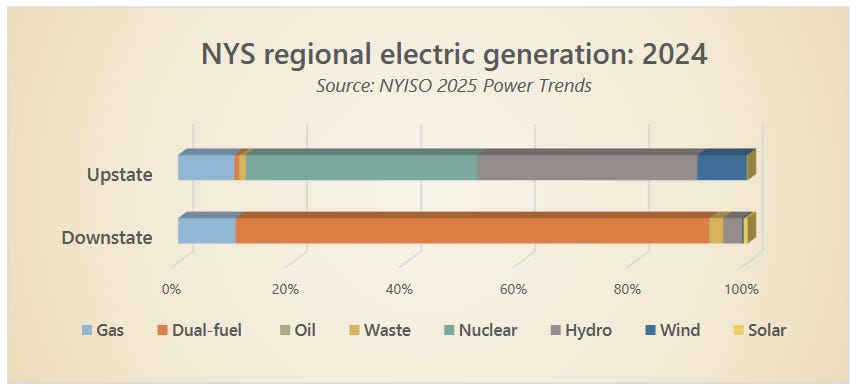
According to the NYS Climate Act, all NYS electricity will be generated by renewable energy by 2040. That date is currently in question, but the essential goal of decarbonization remains. The upstate portion of the grid is already nearly decarbonized. Downstate NY has various options for decarbonizing:
Build renewable energy facilities upstate and build/upgrade transmission infrastructure
Build out offshore wind and transmission infrastructure
Import hydroelectric energy from Canada
The state has been pursuing all these options. But large-scale renewable buildout has been slow, with projects often taking six to eight years from bid submission to operation.[ii] Many offshore wind projects and associated transmission lines have mostly been put on hold due to cost increases and uncertainties arising from federal policy. A transmission line that will bring hydroelectric energy from Quebec to NYC is under construction—but it is not expected to supply electricity during the winter months. This lack of winter power matters, because presently NYS’s electric use peaks during the summer. By 2040, it’s expected to peak during the winter as our electric use changes. In other words, this new energy probably won’t be available when it is most needed.
We’re not just looking at the need to decarbonize the existing downstate grid, of course. Electric demand in the state is expected to double from present levels by 2050. Most home heating will be done with heat pumps, not the gas and oil units that are common now. Almost all vehicles will be emissions-free, including buses, and most will require charging. Demand may increase from data centers and other sources as well.
The energy plantation
Some NYS residents have noted that the upstate/downstate relationship reflects a pattern of neocolonialism in which NYC has dictated upstate land use. Historically, when NYC needed upstate land resources, upstate residents have had no say in the decisions.
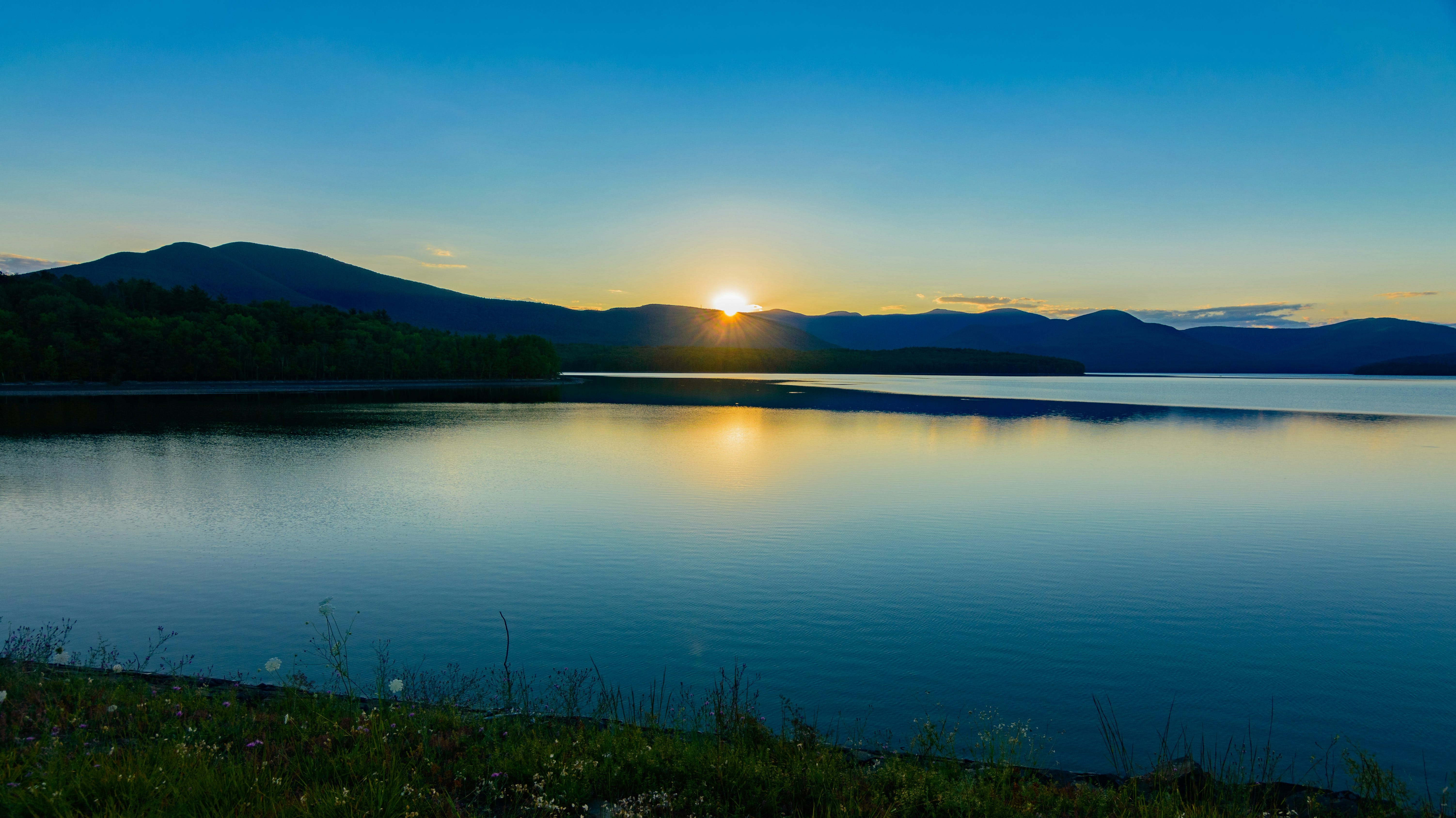
During the 19th and 20th centuries, NYC created 19 reservoirs on upstate land to provide its drinking water supply.[iii] In doing so, they displaced over 5,700 upstate residents and flooded 25 communities, along with surrounding farms and homesteads. Residents were compensated for their losses, but they were given no part in making the decision to submerge their land.
The goal of procuring clean energy for NYC has become a state priority, which has created an alliance between the city, state government, and renewable energy corporations. Consequently, today NYC is effectively establishing what amounts to an energy plantation on upstate land with the full support of state government. Individual property owners may choose whether to lease or sell their land for conversion to grid-scale renewable energy facilities, but communities and adjacent landowners have no decision-making role in siting them.
“Unduly burdensome”
NYS communities may pass laws to control solar and wind development, but the state can override those laws.[iv] Residents may make their opinions known, but developers are not required to take them into account. Issues such as property values and any negative local socioeconomic effects do not have to be considered during the site approval process. [v] If a local law is judged “unduly burdensome” to developers, it may be waived by the state.
Why such a heavy-handed approach? From the state’s perspective, building these projects is a matter of public necessity, just as building NYC’s water supply was. Without upstate renewables, the energy transition cannot move forward quickly, and NYC will not have the emissions-free energy required to meet the state’s Climate Act goals. Put another way, it prioritizes decarbonizing NYS’s electric supply over protecting local communities. This approach risks creating environmental justice communities in a process that mirrors what has occurred with the siting of fossil-fuel plants.
Seeing red—and blue
It might seem odd that a state government dominated by Democrats would take such a paternalistic and authoritarian stance, especially toward economically distressed rural populations. This approach, combined with developers’ use of the “decide-announce-defend” model of community engagement, has been regarded as short-sighted and repressive by many upstate residents.
In fact, the state government’s stance represents an interesting reversal in conventional political roles. The largely Democratic state government and generally Democratic-leaning developers have chosen a decidedly undemocratic approach to siting renewable energy projects, effectively supporting the rights of developers and individual (host) property owners over the rights of the host communities. It is particularly interesting to see Democratic politicians allying themselves with the large corporations that many once regarded with suspicion.
The article “Halfway up the ladder: Developer practices and perspectives on community engagement for utility-scale renewable energy in the United States”[vi] highlights drawbacks of the overall approach taken by developers, supported by the state on behalf of the downstate region. This approach tends to build distrust and lead to feelings of disenfranchisement. The authors characterize the approach as ‘halfway up the ladder’, compared to the idealized vision of full citizen participation:
“Quality community engagement can be a promising pathway for procedural justice – one of the core tenets of energy justice–but it can also be at odds with other goals of decarbonization policy, such as certainty and speed. Meaningful community engagement often necessitates time to build trust with communities, which may conflict with the desire to deploy renewable energy at a swift pace.”
The approach fails to ensure mutual benefits or foster a sense of inclusion. Local knowledge is frequently ignored or dismissed.
And justice for all
Residents of rural upstate communities often express objections to hosting industrial energy projects that generate electricity for downstate NY. Specific concerns include the loss of agricultural land, the potential for groundwater and soil contamination, property value loss, impacts to tourism, environmental degradation, and the transformation of green spaces into industrial facilities.
The state and renewable energy industry point out that these projects create temporary construction jobs that may employ some local residents and bring in additional revenue in the form of payment in lieu of taxes (PILOT) and host community benefit agreement funds. Of course, a PILOT agreement almost always includes a substantial reduction in property taxes, and developers are also receiving millions of dollars in exemptions for sales/use tax and mortgage recording taxes. Meeting NYS’s ambitious climate goals is usually mentioned as a benefit as well.
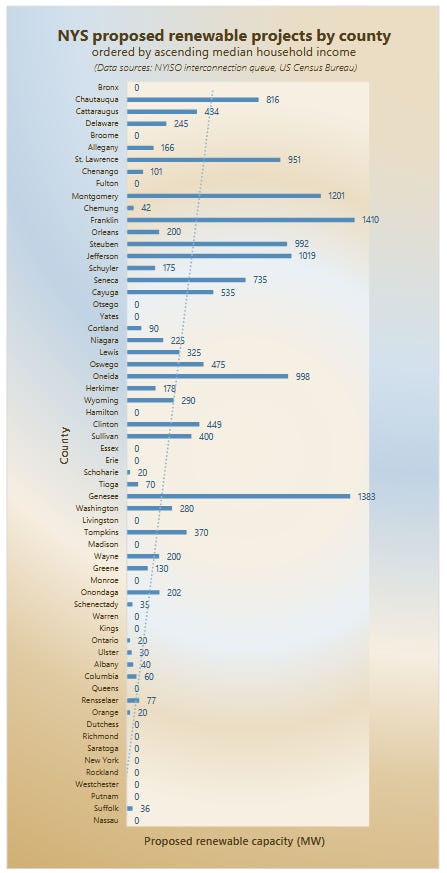
Many projects are being proposed in parts of the state with low household income levels and high unemployment rates. For example, the following chart shows the number of MW of grid-scale solar projects proposed in each county, arranged in ascending order of median household income. As you can see, counties with lower household incomes are more likely to be selected to host renewable facilities. Note that downstate communities are almost all at the wealthier end of the spectrum.
Conclusions
Clearly there is substantial opposition to renewable buildout in upstate NY. Interestingly, political affiliation and belief in climate change do not seem to predict residents’ views.[vii] When grid-scale projects are proposed in their communities, many upstate residents tend to oppose them.
In one study, 42% opposed utility-scale solar facilities in or near their local communities; 14% remained neutral; and 44% supported them.[viii] In fact, a 2023 survey showed that western NY residents only rated their support for large solar plants on productive agricultural or forested land as 1.8/5, where 5=strong support.[ix]
Representatives of the state insist that aggressive Climate Act targets preclude the possibility of meaningful interaction when it comes to engaging host communities. There appears to be little interest in developing more authentic and inclusive community engagement practices. The role of local communities has steadily diminished with the introduction of new legislation.[x]
It is worth putting the state’s aggressive goals into a global perspective here. The state’s priority is to reduce greenhouse gas emissions, but NYS produces less than half a percent of the world’s emissions. While it makes for a noble-sounding goal, decarbonizing the state’s electric supply is unlikely to have a discernable effect on climate change.
NYS communities make decisions for smaller renewable projects (under 20 MW) but not for the ones that will have the greatest impact. While communities receive a variety of payments for hosting large renewable facilities, they also seem to want a say as to where they are sited. States such as Ohio have returned final decision-making authority to communities after a state siting review process;[xi] some projects have been rejected by communities as a result. This approach would seem equitable to many New Yorkers, but it is unlikely to be adopted by predominantly Democratic lawmakers.
Photo of Catskill Mountain reservoir by Tyler Barringer on Unsplash
If you found this post helpful, please hit “like” to boost its place in searches. For a printable copy, please watch for the PDF version.
[i] Robert B. Ward, Downstate Pays More, Upstate Gets More: Does It Matter? Rockefeller Institute of Government website, 15 December 2011, https://rockinst.org/blog/downstate-pays-upstate-gets-matter/, accessed 3 August 2025.
[ii] Po-Yu Yuen, Chinmayee Atre, What will it take for New York’s Tier 1 large-scale renewables to deliver on CES Biennial Review timeline? November 2024, https://sea-ee.com/blog-post/what-will-it-take-for-new-yorks-tier-1-large-scale-renewables-to-deliver-on-ces-biennial-review-timeline/.
[iii] NYC Environmental Protection website, History of New York City's Drinking Water, https://www.nyc.gov/site/dep/water/history-of-new-york-citys-drinking-water.page, accessed 3 August 2024.
[iv] Like many states, NY has a history of handling the permitting of electric power plants at the state level and overriding local concerns. This began with Article X of the Public Service Law and was extended for renewables as Article 10. Section 94-c of the Executive Law continued the process, and most recently Article VIII of the Public Service Law. Local input has been all but eliminated.
[v] The topics of socioeconomic effects and property values were discussed in several early Article 10 hearings, where the Public Service Commission concluded that it was not obligated to take them into account in approving projects.
[vi] Robi Nilson, Joseph Rand, Ben Hoen, Salma Elmallah, Halfway up the ladder: Developer practices and perspectives on community engagement for utility-scale renewable energy in the United States, Energy Research & Social Science, Volume 117, 2024, 103706, ISSN 2214-6296, https://www.sciencedirect.com/science/article/pii/S2214629624002974.
[vii] Roberta S. Nilson, Richard C. Stedman, Reacting to the Rural Burden: Understanding Opposition to Utility-Scale Solar Development in Upstate New York, Volume88, Issue2, June 2023, https://onlinelibrary.wiley.com/doi/abs/10.1111/ruso.12486.
[viii] Nilson, Stedman, Reacting to the Rural Burden.
[ix] Roberta S. Nilson, Richard C. Stedman, Are big and small solar separate things?: The importance of scale in public support for solar energy development in upstate New York, Energy Research & Social Science, Volume 86, 2022, 102449, ISSN 2214-6296, https://www.sciencedirect.com/science/article/abs/pii/S2214629621005363.
[x] For example, Article 10 allowed two ad hoc members from local communities to join the board responsible for siting grid-scale renewable energy facilities; this was discontinued when Article 10 was replaced with Section 94-c.
[xi] Peggy Kirk Hall, New laws and new resources on wind and solar facility siting in Ohio, Ohio State University Extension Farm Office, 13 October 2021, https://farmoffice.osu.edu/blog/wed-10132021-438pm/new-laws-and-new-resources-wind-and-solar-facility-siting-ohio.
Good article. Having been raised in upstate NY, and now a resident of Oregon, I've noticed some interesting parallels. although this is a little off topic.
Albany is the capital, but NYC is much, much bigger.
In Oregon, Salem is the capital, but Portland is much, much bigger.
Upstate NY is mostly rural; Eastern Oregon is mostly rural.
The Adirondack State Park is the largest state park in the lower 48.
In Oregon, much of the state is state or national forest.
Both states have some great apple production - the Hudson Valley and Hood River valley.
In both states, the small towns are not growing, in fact, they seem to be getting smaller.
Fantastic, thank you!