
Seeing all the sites
Alternatives to building out NYS solar on farmland

“Solar belongs on rooftops and parking lots, not farmland.”
I hear this kind of comment a lot. So many people seem to feel we should use farmland as a last resort when it comes to siting solar.
NYS takes a first-come, first-served approach to grid-scale solar siting. Rather than employ a strategy and criteria, the state lets developers select sites and approves their permits. Typically, those developers look for land that’s flat, clear, sunny, and located near transmission and transportation infrastructure. In other words, they choose farmland—often highly productive farmland.
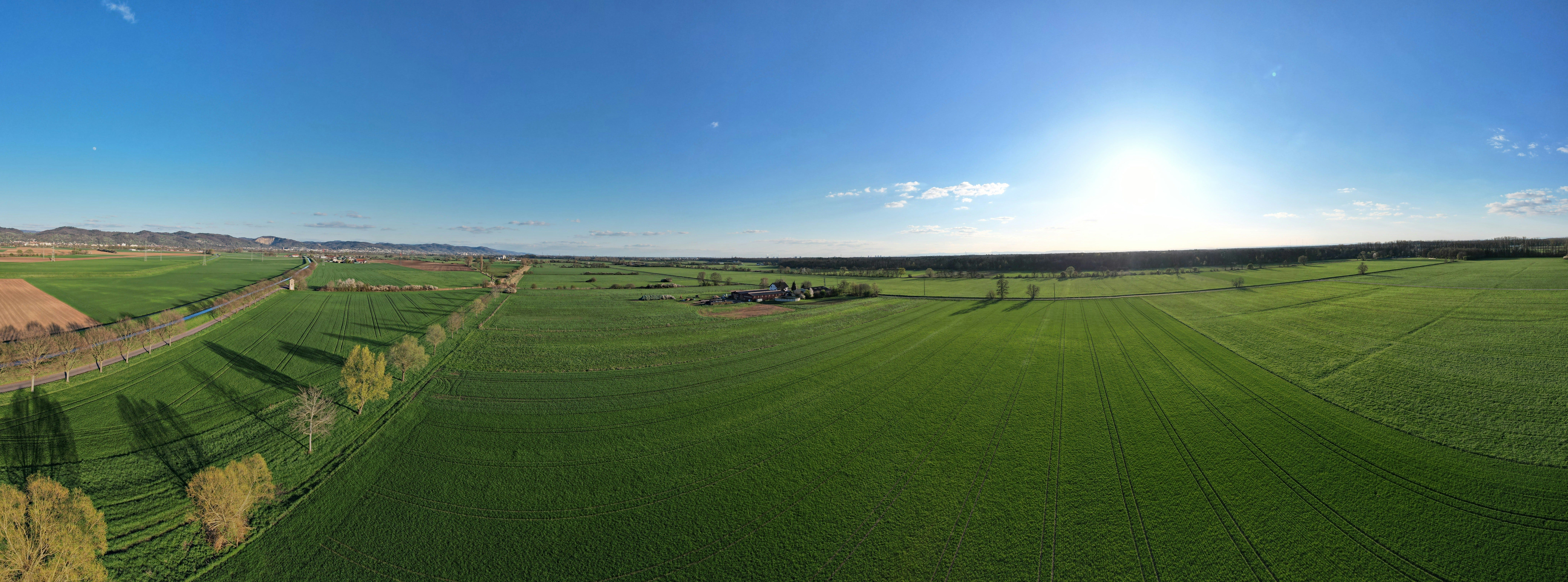
Solar developers will tell you privately that they prefer dealing with local officials with limited experience and knowledge of solar development. Consequently, grid-scale solar projects in upstate NY are often sited on farmland in small, rural communities where people are struggling to make ends meet.
In my white paper Enough land and its 2025 update, I estimated how much farmland NYS solar buildout would require: hundreds of thousands of acres. While the state isn’t going to run out of agricultural land tomorrow, it’s a precious, finite resource. Once converted to solar development, it is unlikely to be returned to farming anytime soon.
And it isn’t just food production that opponents of some solar projects want to protect. Forests and grassland habitat are at risk as well.
Some will argue that agrivoltaics could make this choice less controversial by continuing the agricultural use of farmland, but there are very few large agrivoltaic projects planned for upstate NY. The few plans that exist amount to sheepwashing: using sheep grazing to give the appearance of continued agricultural use. Real agrivoltaic projects are expensive, and the cost of solar in upstate NY is already high.
Absence of strategy
The state has shown remarkably little interest either in the environmental damage that can be done by solar projects or in the loss of productive farmland.
After the developer selects a solar site and secures the land, the NYS Office of Renewable Energy Siting (ORES) reviews and approves the project application. ORES has never rejected such an application due to siting issues. Projects are routinely approved on productive farmland, forested land, wetlands, and habitat for threatened and endangered species.
ORES appears to view its job as one of confirming developer choices. The state has offered some very minimal discouragement from building on highly productive farmland by requiring mitigation payments, but these have become a cost of doing business for developers. Occasionally habitat mitigation is required, but at far less than a 1:1 acreage ratio. In the case of some threatened and endangered species, developers can simply pay into a fund rather than set aside land.

Alternative sites
Could solar projects be sited somewhere other than farmland? Yes, but not easily, and it would be (more) expensive. In the absence of a considered, coherent siting strategy, we can expect about 83% of solar development to take place on farmland.1
The state pays lip service to encouraging alternative siting through its “build-ready solar” program, which encourages solar on landfills and other brownfield sites, as well as on parking lots. But this is a very limited program with minimal effects on overall buildout trends.
What are the alternatives? Aquavoltaics could expand solar buildout onto NYS’s lakes, rivers, and canals. This technology is relatively new and untested in our climate. We need to do more research to ensure that no contamination will occur from the leaching of damaged/delaminated panels or sloughing of coatings that may contain PFAS chemicals. Research frameworks have been proposed;2[ii] We won’t have results for years.
Three other popular alternatives are available: landfill/brownfield sites; residential, commercial, and industrial rooftops; and parking lot canopies. All these approaches have a great deal of popular support.
I’ll look at the feasibility of each option and compare costs. I’ll also evaluate how much potential capacity each one represents, where it can be determined. There are few published sources of information on the cost of certain types of systems, and costs within a category may vary widely. After checking their assumptions, I used Perplexity AI and Grok to help compile cost information. Their estimates were very close to one another and matched what I’ve been able to piece together on my own.
Alternative: Landfills and other brownfield sites
According to Scenic Hudson, NYS has over 3,000 closed landfills.3 The state actively encourages building solar on them where feasible, and some have already been used for solar projects, in places like Fort Edward and the Town of Ulster. The state offers incentives that bring the cost of these projects close to grid-scale solar for developers, but of course incentives don’t lower the cost for ratepayers and taxpayers.
The challenge lies in determining which landfills will make appropriate sites, as many are too small (under 6 acres) or too remote for easy interconnections to the grid. Because many landfills tend to be under 100 acres, building solar on them is more expensive in general than grid-scale solar buildout. Developers can’t take advantage of the same economies of scale that help make large projects profitable.
Installing solar on a landfill requires specialized engineering and permitting, and it poses certain environmental risks. Instead of driving piles into the ground to support panels, developers use concrete ballasts to secure the racking. Such differences in engineering considerations and construction lead to higher costs.
Brownfield sites in NYS pose similar challenges, and again the state has no inventory that evaluates suitability for solar development. Sites must be remediated on an individual basis before construction can begin, so these are potentially complex sites that may be time-consuming to develop.
According to Perplexity, the cost per watt of installing solar on landfills averages about $3/watt, and the levelized cost of energy (LCOE) averages about $150/MWh—50% higher than greenfield solar. For purposes of comparison, grid-scale solar buildout on greenfields can be expected to cost about $2/watt, and the LCOE will likely be $100/MWh as of 2026.
If NYS is serious about using landfills and brownfields, they should be inventoried and evaluated for solar potential. No total acreage is available for closed landfills in the state, so we are left to speculate on the topic. I’ll assume that of 3,000 closed landfills, perhaps 25% are suitable for solar: appropriately oriented, over 6 acres in size, and located with reasonable interconnection access. If we assume a fairly conservative average of 20 acres per landfill, this gives us 15,000 acres that could host a total of 2,500 MW of solar.
Alternative: Commercial and residential rooftop solar
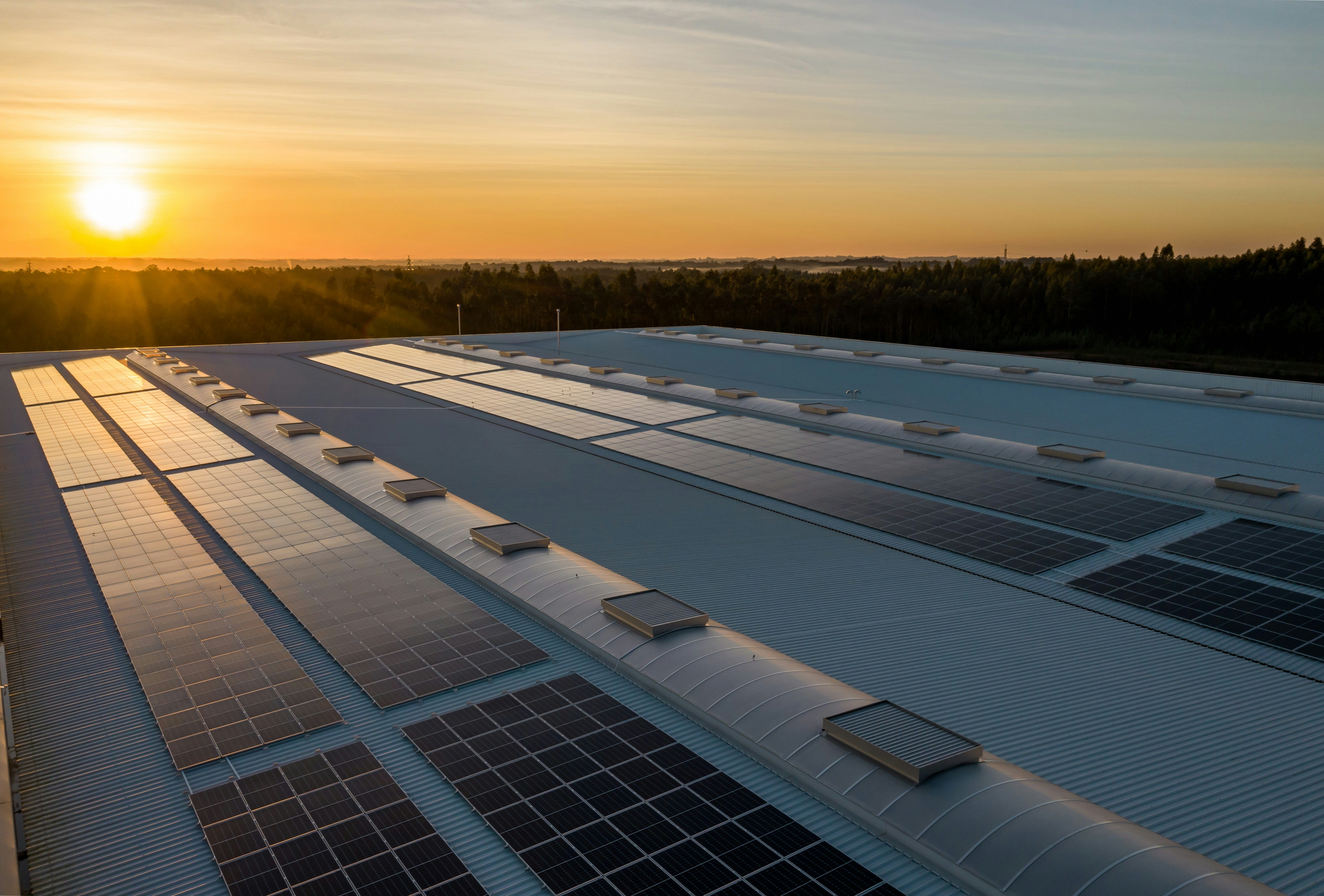
Solar on commercial and residential rooftops instead of farmland sounds like a terrific idea to most people. Shouldn’t all commercial buildings be required to sport arrays?
As it turns out, many existing commercial buildings can’t support rooftop solar from a structural standpoint or would need considerable reinforcement. Installing arrays on rooftops makes firefighting more difficult. Municipalities can be reluctant to allow it for safety reasons, so many rooftops will remain bare even if it seems like a great option.
We would need alternative financing structures to provide funding for every commercial or residential rooftop. Much of the current financing available for purchasing rooftop solar is provided through NYSERDA loans; it would be impractical to extend these to every household.
Even if the state could provide loans, large numbers of residents and businesses may not be in a position to trade their utility bill payments for the debt that this entails. Lease arrangements have been fraught with their own set of problems; these would need to be resolved on a statewide level. The requirement for rooftop solar would also drive up new construction costs, as it has in California.
In NYS, Perplexity estimates that installing commercial rooftop solar costs about $2.20/watt, and the LCOE averages about $110/MWh—only about 10% higher than for grid-scale greenfield solar. That’s the good news. The bad news is that residential solar really isn’t cheap. On a national level, the LCOE of residential solar was about three times that of utility-scale installations.4 Perplexity’s estimate for NYS residential solar costs was $3.15/watt and $158/MWh—about 58% higher than greenfield solar.
The National Renewable Energy Laboratory (NREL) tracks rooftop solar potential in “Rooftop Solar Photovoltaic Technical Potential in the United States: A Detailed Assessment.”5 NYS has 340 million square meters of rooftop space (residential and commercial) that could potentially be used for solar. NREL estimates these rooftops could have a capacity of up to 46,600 MW.6
Alternative: Parking lot canopy solar
France mandates solar canopies on most parking lots over 80 spaces; this is a politically popular, very expensive way to generate solar energy on a large scale. Installing solar panels over parking lots sounds like another great idea. It uses already industrialized land and serves the added function of providing shade and shelter.
But it is far more expensive than building out solar on farmland. Costs may be especially high in some parts of upstate NY, where engineers must consider snow load and high winds. Solar parking canopies require more steel and other materials than ground-mounted greenfield solar, again driving up costs, and overall engineering/construction is more complex.
Perplexity puts the cost per watt of installing parking lot canopy solar average at about $3.30/watt, and the LCOE average at about $165/MWh—about 65% higher than for grid-scale greenfield solar.
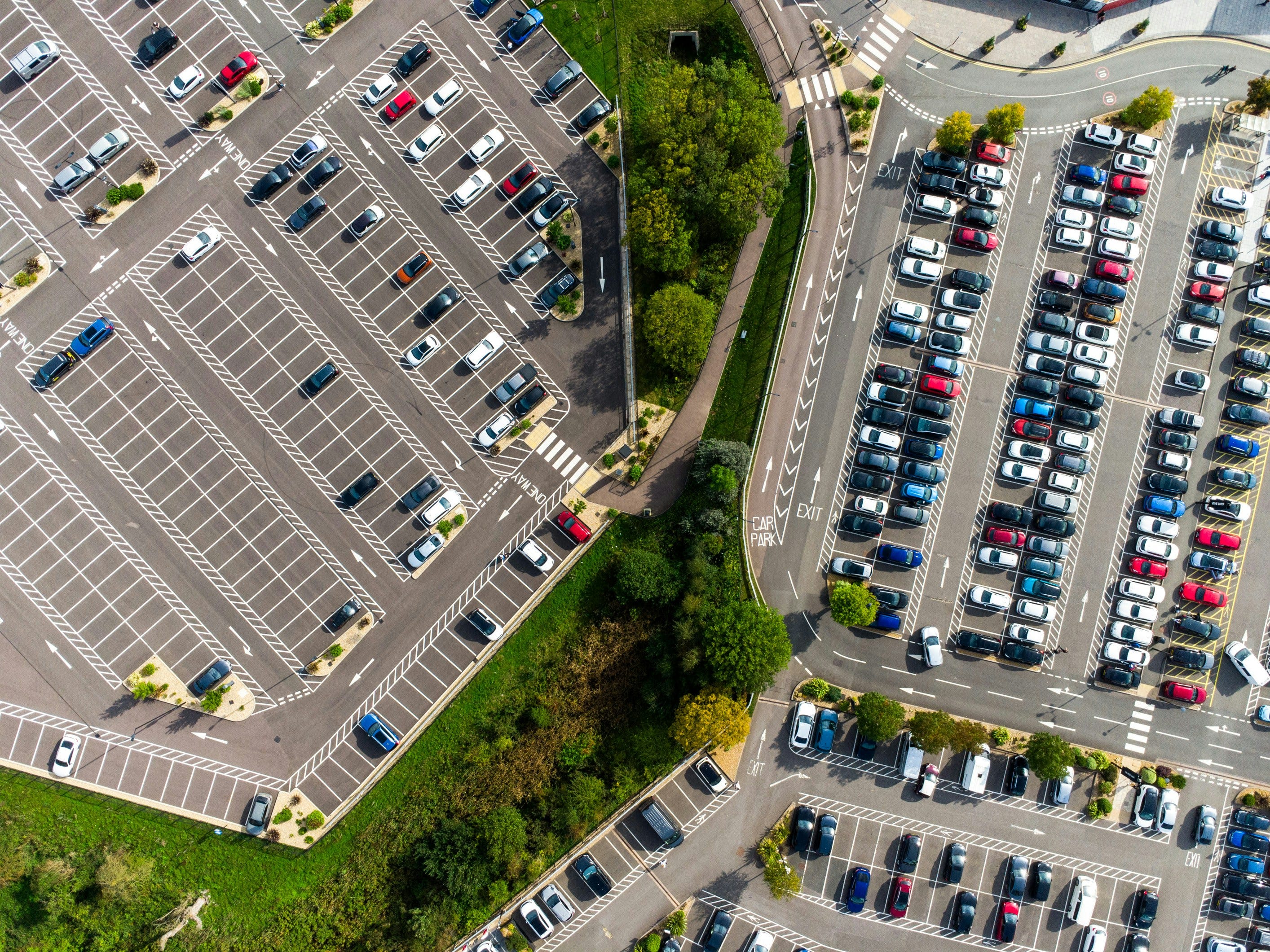
How much potential parking lot solar could we build? It’s nearly impossible to say. Most parking lots are located in urban and suburban environments; NYC has opened up 8,500 acres of urban parking lots to potential solar development. An undated study from SUNY Albany evaluated parking lot solar potential in 19 counties in the downstate region and Hudson Valley; it found 9,823 acres that could be used for an estimated 2,947 MW of capacity.7[vii] It would seem safe to assume that the state has double that capacity when including all other urban and suburban areas across all 62 counties. The counties evaluated are significant because they are located close to the center of demand: metropolitan NYC. I’m going to assume a capacity of up to 6,000 MW for parking lots across the state.
Comparing costs
Here are the costs per watt and LCOE for each alternative:
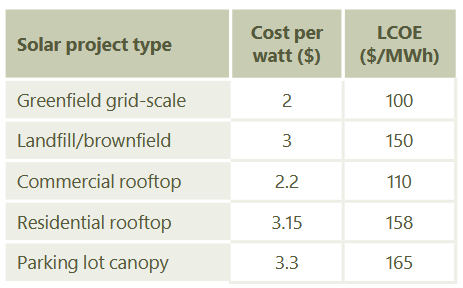
Few would dispute that any of these alternative sites would be preferable to productive farmland in many respects, and some would argue that we should prioritize building in these alternative locations. The question remains: Can we afford these alternatives?
In 2040, for instance, we would need about 44,000 MW of solar to meet the Climate Act’s “70 by 30” target. What would be the impact of shifting that buildout from installations on farmland to parking lot solar?
At current rates, that much greenfield solar would cost $88 billion to construct, and parking lot solar would cost $145 billion. The cost of the energy generated from these projects would be considerable as well. If we generated all our solar electricity over parking lots, it would cost almost $11.5 billion a year, compared to about $7 billion for greenfield solar.
If we need 44,000 MW of grid-scale solar capacity by 2040, much of this amount could theoretically come from a combination of landfill, rooftop, and parking lot solar. But the cost and timeframe for deployment would make a full-scale switch completely impractical. Note that the costs I’ve listed here are strictly for comparing greenfield solar with the alternatives; the actual cost of providing adequate transmission, backup generation, and battery storage for solar is much higher than the LCOE indicates. The full cost of landfill, rooftop, and parking lot solar as an alternative to greenfield solar would likely be completely prohibitive.
NYS greenfield solar buildout: How much land will it require?
Most residents aren’t aware of the proposed scale of solar buildout in NYS. Many haven’t seen a grid-scale solar plant. Some have seen modest 3-5-MW community solar installations. These feature just 18-30 acres of panels, yet I hear people describe them as “huge” and “enormous.”
Folks have no idea what’s coming down the pike.
A 100-MW solar plant uses around 600 acres of land—usually farmland. If we build out enough grid-scale solar to meet Climate Act requirements, we’re looking at 264,000 acres of solar—over 400 square miles—most of which would be farmland. By 2050, we’re likely to need 65,000 MW of grid scale solar: 390,000 acres or over 600 square miles. That’s twice the area of NYC. The size of a small NYS county. But it’s difficult to imagine something becoming a common part of the landscape that you’ve never seen.
As I indicated in Enough Land, solar development by itself will not reduce our supply of productive farmland to a degree that’s unsustainable in the immediate future. When taken together with other causes of farmland conversion, however, the numbers start to add up. As I’ve said before: We need to stop building things on productive farmland.
Should grid-scale solar be an exception to that rule? Is it such a necessary, benevolent land use that it’s desirable—or at least justified? Is it acceptable to eliminate large areas of sensitive habitat and to clear-cut forests for solar? People must decide for themselves whether they support this level and type of solar buildout.
The irony of this situation is worth noting. While environmental damage done to install solar is real and tangible, our efforts to stop climate change amount to virtue-signaling. Since NYS generates less than 0.5% of global emissions, our solar buildout won’t result in any measurable impact on climate change. NYS residents need to consider what is acceptable as we move forward. Is it worth the added cost to put solar on alternative sites? Or is it time to reassess the goals and timeframe of the Climate Act itself?
Thanks for reading my post. I hope you found it useful. If you think it might help others, please click “like” to boost its position in Substack searches and to support my work.
Photos by Bernd Dittrich, Nuno Marques, and Benjamin Cheng on Unsplash, and Kris Martin.
Ann Sorensen, PhD, Theresa Nogeire, PhD and Mitch Hunter, PhD, potential placement of utility-scale solar installations on agricultural lands in the US to 2040, Americal Farmland Trust, November 2022, https://farmlandinfo.org/wp-content/uploads/sites/2/2023/03/AFT_FUT2040-solar-white-paper.pdf.
Moreen Akomea-Ampeh, Eliot A. Atekwana, Elliott P. Steele, Alex E. Cagle, Alona Armstrong, Stephen J. Thackeray, Steven Sadro, Olusola O. Ololade, Olatubosun A. Fasipe, Rebecca R. Hernandez, Metal contaminant risk at active floating photovoltaic sites and future research roadmap, Journal of Environmental Management, Volume 383, 2025, 125216, ISSN 0301-4797, https://doi.org/10.1016/j.jenvman.2025.125216.
Scenic Hudson, Siting Solar PV Projects on Previously Disturbed Lands: Landfills and Brownfields.
US Department of Energy, Solar Photovoltaic System Cost Benchmarks, https://www.energy.gov/eere/solar/solar-photovoltaic-system-cost-benchmarks, accessed 13 January 2026. The LCOE tends to be very favorable to solar generation, as it doesn’t include the cost of transmission upgrades or backup energy sources.
Gagnon, Pieter, Robert Margolis, and Caleb Phillips. 2019. “Rooftop Photovoltaic Technical Potential in the United States.” NLR Data Catalog. Golden, CO: National Laboratory of the Rockies. Last updated: January 21, 2025. DOI: 10.7799/1575064, https://data.nrel.gov/submissions/121.
Note that this number may represent 46,600 MWdc, which is quite a bit less than 46,600 MWac; amounts for NYS requirements are in MWac. The conversion is not simple, but 46,600 MWdc would be less than the 44,000 MWac that NYS expects to need by 2040.
Lucas Root, Richard Perez, Photovoltaic Covered Parking Lots: A Survey of Deployable Space In the Hudson River Valley, New York City, and Long Island, New York, Atmospheric Sciences Research Center, The University at Albany, https://research.asrc.albany.edu/people/faculty/perez/publications/Other%20Papers%20and%20Applications/parkings.pdf.
Great analysis. It describes the solar issues facing NYS. More information showing that the Climate Act must be paused to fully understand the potential impacts.
Why spend more money to get more intermittent wind and solar into the system?
Unsubsidised wind power off-grid, OK. Unsubsidised rooftop solar, not feeding into the grid OK!
Trillions have been spent around the western world on RE and we have got more expensive power, blackouts looming, inertia, voltage and frequency issues growing, and incalculable enviro damage from the third world to the forests and farmlands of the west. The most bitter legacy may be the bitter division of families and communities in the country, but what to city folk know or care about that?
https://rafechampion.substack.com/p/losing-the-war-on-co2
https://rafechampion.substack.com/p/the-green-energy-transition-is-all
https://rafechampion.substack.com/p/wind-and-solar-the-energy-thieves-a0c